
Quality Standards and Everyday Care Guide
This is the document we hand to a new maker on their first week at the Burlington bench, written out for the households that live with the results. It covers how we grade stock, how we cut and finish it, and the ordinary upkeep that carries a household system from its first year to its thirtieth.
Part One: Bench Standards
Hardwood grading and moisture
We buy North American hardwood in the rough and grade it ourselves. Stock is kiln-dried and then rested in the shop until it reads between seven and eight percent moisture content on a pin meter, which matches a heated American home across a full winter. Boards with case-hardening, pith, or a knot within two inches of a joint line are set aside for jigs.
- Black walnut for interior trays, counters and shelving
- Quartersawn white oak wherever humidity swings, including entry and mudroom work
- Hard maple for racks, bowls and anything that takes repeated impact
- American cherry for end-grain boards and turned handles
Joinery standard
Corners are hand-cut through dovetails. Rails and stiles are mortise and tenon. Glue is used to support a mechanical joint, never to stand in for one, and we do not use staples, brads or plastic corner clips anywhere in the catalog. A joint that can be cut can also be repaired twenty years later.
Finishing standard
Three coats of hand-rubbed beeswax and pure tung oil, each cut back with 400-grit abrasive and allowed to cure before the next. Total cure is fourteen days before a piece leaves the shop. We avoid film finishes on household systems because a film eventually chips exactly where a hand lands, while an oil-and-wax surface wears evenly and renews with a cloth.
Hardware and textiles
Solid cast brass and hand-forged iron, left unlacquered so a patina can develop. Fasteners are standard American sizes available at any hardware counter, so a repair never waits on a proprietary part. Textiles are eighteen-ounce waxed cotton canvas, undyed felted New England wool, and four-to-five-ounce vegetable-tanned bridle leather.
Part Two: Everyday Care by Material
Oiled hardwood: trays, shelving and boards
Wipe with a barely damp cloth and dry immediately; standing water is the only real enemy. Recondition with beeswax and flaxseed every ninety days for pieces in daily service, twice a year for storage shelving. Apply a quarter teaspoon per square foot with the grain, let it stand twenty minutes, then buff off everything that has not absorbed.
- Keep trays out of a dishwasher and away from prolonged direct sun
- Lift a water ring with a light 600-grit pass, then re-oil the area
- Rotate end-grain boards each use so both faces wear at the same rate
Cast iron: skillets, griddles and conditioning
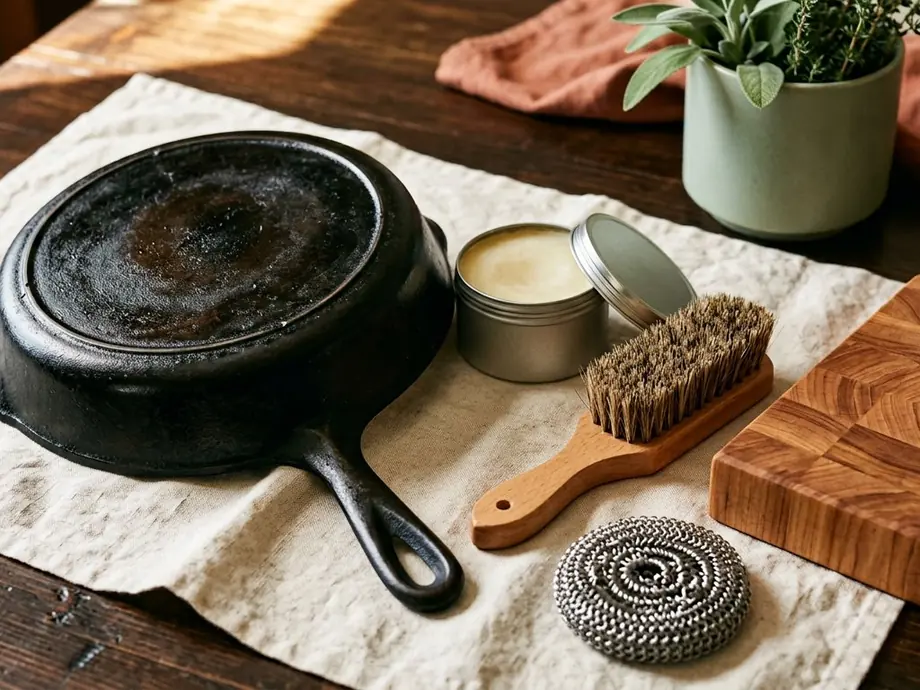
Wash warm with a chainmail scrubber and little or no soap, dry on a low burner until the surface flashes dry, then wipe a few drops of oil across the cooking face while the pan is still warm. A full seasoning pass once a season rebuilds the patina: a very thin oil coat, inverted in a 450-degree oven for one hour, cooled in the oven.
Solid brass and forged iron
Unlacquered brass darkens with handling, which is the point. Leave it alone and it will deepen to a warm bronze; polish it with a cream polish and a soft cloth and it returns to bright in about ten minutes. Forged iron wants a yearly wipe of paste wax, particularly on hooks near an exterior door.
Waxed canvas, wool and leather
Brush waxed canvas clean and spot-clean with cold water; refresh the wax coat with a bar wax and a hair dryer once a year or whenever the fabric looks thirsty at the fold lines. Felted wool spheres need only air. Bridle leather pulls take a thin coat of neatsfoot or leather balm twice a year.
Cedar, cork and stoneware
Cedar blocks stop working when the surface closes; a light sanding each spring reopens the grain and restores the aroma. Cork liners lift out for cleaning and go back dry. Glazed stoneware is dishwasher-safe, though a quick hand wash keeps the unglazed foot ring from chalking.
Part Three: The Four-Season Upkeep Calendar
Spring
- Sand cedar blocks lightly and rotate the linen closet sets
- Re-wax forged iron hooks in the entry and mudroom
- Lift and clean cork drawer liners, then re-oil the trays beneath
Summer
- Refresh the wax coat on canvas repair rolls and totes
- Check pull weights on loaded trays and bins; thin what has crept in
- Balm the bridle leather pulls on storage bins and ties
Autumn
- Full cast iron seasoning pass before the heavy cooking season
- Recondition every hardwood surface in daily service
- Set out the boot tray and confirm the hook rail bolts are snug
Winter
- Watch for dry-air movement at quartersawn joints and ease drawer runs if needed
- Replace felt furniture pads before the dry season scratches a floor
- Polish or deliberately leave the brass, depending on the patina you want by spring
Part Four: Service, Repair and Replacement Parts
Every piece carries a stamped specification code on an unseen face, and that code is recorded in the studio log alongside the board it was cut from. Send us the code and we can match a replacement divider, a brush head, a canister gasket, a leather tie or a set of cedar blocks years after the original left the bench.
Repairs are done at the Burlington bench on a first-in basis, typically within three weeks outside the autumn rush. Write to the studio with the specification code, a short description and a photograph, and we will tell you plainly whether a repair, a replacement part or simple reconditioning is the right call.
Compare Options Before You Commit
If you are weighing one room against another, the room explorer on the household showcase filters all twelve catalogued entries by room, and the selection bench assembles a reference code you can send to the studio with your question.